
First Contact
Technical documentation for the First Contact protocol — how messages, images, and NFTs are composed, verified on Solana, encoded for 2–5 GHz radio transmission via SpaceSpeak, and tracked across 30 celestial milestones.
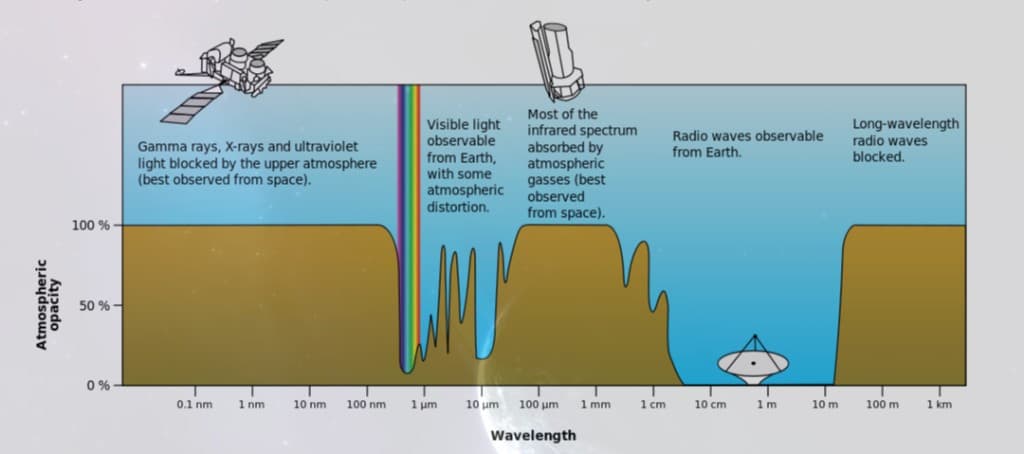
Earth's atmosphere absorbs most of the electromagnetic spectrum. The radio transparency window (roughly 1 cm–10 m wavelength, 30 MHz–30 GHz) is one of the few bands where signals can exit the atmosphere and propagate indefinitely into space. SpaceSpeak transmits in the 2–5 GHz portion of this window- the same band as NASA's Voyager deep space communications.
Send a Signal in 3 Steps
First Contact lets anyone transmit text messages, images, or NFT metadata into deep space via SpaceSpeak's parabolic radio network — permanently and at the speed of light. Here's how:
Paying with $K9 gets you a 10% discounton every transmission. Text: ~5,000 K9 (vs $2.50 USDC). Image: ~10,000 K9 (vs $5.00 USDC). Don't have K9? Use the built-in deBridge widget on the Send page to swap any token from any chain into K9 on Solana.
Why 2–5 GHz Radio
The electromagnetic spectrum is mostly blocked by Earth's atmosphere. Gamma rays, X-rays, and ultraviolet light are absorbed in the upper atmosphere. Most of the infrared spectrum is absorbed by atmospheric gases. Long-wavelength radio waves (>10 m) are reflected off the ionosphere and cannot escape into deep space.
There is a narrow radio transparency window — approximately 1 cm to 10 m wavelength (roughly 30 MHz to 30 GHz) — where the atmosphere is nearly opaque to external radiation but allows outbound transmissions to pass through. This is the window that SpaceSpeak exploits.
First Contact operates in the 2.4–5 GHz band. This is the same frequency range used by NASA's Voyager 1 and 2 probes, currently the farthest human-made objects from Earth. At these frequencies, the atmosphere is nearly transparent, beam divergence is manageable over interstellar distances, and parabolic dishes can tightly focus the signal.
Transmitter Network
SpaceSpeak was founded by Dr. Peter Beery and operates a Phase I transmitter network in Tampa (FL) and Austin (TX), USA, and Brazil. Each site runs low-wattage transmitters coupled to parabolic dish antennas. The parabolic geometry focuses the broadcast into a tight beam, increasing effective radiated power by up to 300× compared to an isotropic antenna.
Phase II is an open, distributed STEM network of micro-transmitters. Each node uses Yagi directional antennas focused in a 20° cone- keeping the signal coherent across interplanetary distances. Combined, the nodes create a mesh that can target different regions of sky, giving messages wider angular coverage in deep space.
SpaceSpeak has set a Guinness World Recordwith Fun Kids UK for the first radio programme transmitted to deep space. It has been featured on History Channel's Project Blue Book and YouTube Premium's Mind Field.
How the Solana Rail Works
First Contact is Solana-only. There is no custom smart contract — payments are simple native transfers verified server-side against the Solana RPC. This keeps fees under $0.001 and finality under 400 ms.
| Token | Transfer type | Verification method |
|---|---|---|
| SOL | SystemProgram.transfer (lamports) | Parsed ix destination check + balance delta fallback |
| USDC (SPL) | SPL transferChecked | Parsed ix mint + destination ATA + amount check |
| K9 (SPL) | SPL transferChecked | Parsed ix mint + destination ATA + amount check |
The server verifies: (1) the transaction is finalized and not reverted; (2) the fee payer matches the submitted wallet address; (3) the correct token was transferred to the treasury in the correct amount. Only then is SpaceSpeak contacted to queue the relay.
For Solana NFTs, metadata is transmitted from the wallet's DAS (Digital Asset Standard) record via the Alchemy API. The original NFT is never moved — only its metadata is encoded into the radio payload.
Token Payment Matrix
First Contact runs exclusively on Solana mainnet. Three payment tokens are supported — all confirmed on-chain before SpaceSpeak queues the relay. Prices are fixed (not oracle-fed) and denominated in USD equivalent at submission time.
The K9 loyalty discount is fixed at 10% off the USDC/SOL equivalent price. K9 token amounts are rounded to the nearest 500 K9 and computed at a reference rate of ~$0.00045/K9. SOL amounts are computed at a reference rate of ~$170/SOL.
All three tokens are verified server-side against the on-chain transaction: K9 and USDC use SPL transferChecked instructions scanned from the parsed instruction tree. SOL uses a SystemProgram.transfer instruction to the treasury, with a balance-delta fallback.
Distance & Milestone Calculation
Once the on-chain transaction is confirmed and SpaceSpeak queues the payload, the platform begins tracking signal distance using the formula:
This is compared against 30 pre-defined celestial milestones ordered by distance from Earth, from the ISS at 408 km to Tau Ceti at 11.9 light-years. Each time a signal passes a milestone, the user can share the achievement on X.
The 30 milestones span seven orders of magnitude- requiring a logarithmic scale to visualize meaningfully. Early milestones (Moon, GPS belt, L2) are passed within seconds to minutes of launch. The outermost milestones (Proxima Centauri, Tau Ceti) will not be reached for thousands of years — but the signal will still be traveling when it arrives.
How Likely Is Extraterrestrial Life
First Contact does not claim confirmed extraterrestrial contact today. What it does assume is statistical scale: our galaxy alone contains roughly 100–400 billion stars, with planetary systems appearing to be common rather than rare.
Current exoplanet data suggests that a meaningful fraction of stars host rocky worlds, and a subset of those can exist in temperate zones where liquid water is possible. Even with conservative assumptions, this implies millions to billions of potentially habitable worlds in the Milky Way alone.
Zooming out, the observable universe contains on the order of trillions of galaxies. The project premise is simple: if star systems are this numerous, transmitting durable signals into space is a rational long-horizon bet on future discoverability- by humans, post-humans, or non-human intelligences.
Why Transmitted NFTs Are Immortal
Digital assets — including NFTs — depend on the continued operation of servers, blockchains, and human infrastructure. If civilization were disrupted, every IPFS node, every blockchain validator, and every metadata server could go dark. The NFT would cease to exist in any recoverable form.
A radio-transmitted NFT is different. The photons carrying the payload leave Earth at the speed of light and cannot be recalled, censored, or deleted. They require no servers, no validators, no energy input. They carry the content hash, contract address, token ID, and image data encoded into the radio waveform- traveling perpetually through space.
Any sufficiently advanced receiver encountering the signal- human or otherwise- could reconstruct the original artifact. This is the premise of deep-time cultural preservation: the cosmos as the most durable storage medium in existence.
Once your payload exits Earth's atmosphere as a coherent 2–5 GHz beam, no human or institution can stop it. It will pass the Moon in 1.3 seconds, Mars in 3 minutes, the heliopause in 16 hours, and Proxima Centauri in 4.24 years- carrying your message, your NFT, or your voice into a universe that is 13.8 billion years old and counting.